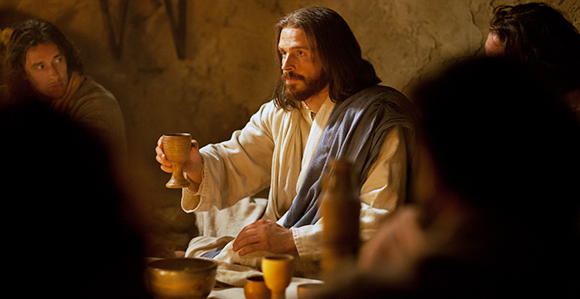
Perhaps you have heard of even used the phrase, “breaking bread” with someone. It obviously has biblical origins. More casually, it’s used to mean “to share a meal with someone.” But “this expression means more than just eating; it is sharing a sense of brotherhood with someone or some group of people. It is a significant event that fosters some meaningful connection and cooperation. Perhaps you are enemies; breaking bread with someone indicates a sense of forgiveness and moving forward to the affair.” More formally, it is meant to express the experience of taking the sacrament.
I was going to wait to share sentiments on the sacrament when I was further into the Book of Mormon. But today I had such a great discussion about this with my sons that I wanted to share thoughts and insights now. So, I’d like to break down the wording of the sacrament prayers in Moroni 4:3 & 5:2. Please pray for your own discernment and understanding of the meaning, significance, and power of the sacrament.
Moroni 4:3
- O God, [God is plural. God is one male and one female in a singular unit with infinite units.]
- the Eternal Father, [You are addressing the eternal, fraternal (male) order of the spiritual Fathers… those that have ascended or progressed to and fulfilled the requirements of a Christ/Savior. Our Savior (Yeshua) had a Savior and He also had One before that and so forth. Every Savior has a Father. Every Father is a Son to their own spiritual Father. (A spiritual Father is different from what you could call a “Creation Father”—one that creates spirits.]
- we ask thee [You are addressing/petitioning Them (the eternal order of the Fathers because They have the power. They are the source of all light, all truth, all righteousness, all goodness, and therefore the God(s) of light, truth, and righteousness.]
- in the name of thy Son, Jesus Christ, [This is Yeshua. He is being put forward and sponsored by the Eternal fraternal order of the Fathers and assigned as the God of Light for this world. There are many Gods but this is the only relevant God to you. His role is to fulfill the promise/covenant of offering eternal life through an intimate, personal relationship with each soul that chooses to “come unto Him.” This is also the predominant theme and invitation throughout the Book of Mormon—to “come unto Christ.” You could just as well say, “Come unto your Christ who is Yeshua/Jesus.” “The name” is referring to the specific identity of the sponsored Savior but also the complete embodiment of His works of righteousness—fulfilling the atonement in the Garden of Gethsemane—which is now permanently part of Him. Having fulfilled the atonement, He is now authorized to personally offer you eternal life—which is to say that you can now progress into the eternities, and Yeshua/Jesus will be your assigned personal mentor throughout your eternal progression. He is now your Lord—the one and only person that can offer you eternal life. You receive eternal life when you have been baptized by both water and more importantly by fire/light/spirit. (“born again”, justified by the spirit, Moses 6:59-60)]
- to bless and sanctify this bread to the souls of all those who partake of it; that they may eat in remembrance of the body of thy Son, [That by partaking of this sacrament, it will be for your own good and further your journey, further your personal development, and personal relationship with your Lord. How would this help? Because it recenters you on your personal relationship with your Lord—the only one that can truly help/save you. Bread has a significant meaning. Bread is symbolic of the experience of flesh (the telestial world). Broken bread is symbolic of a broken heart and a contrite spirit. Bread is symbolic of suffering the telestial world through the condescension of your Lord, His experience of the physical agony of the atonement. It is also symbolic of your own personal sacrifice of a broken heart and contrite spirit. Bread is taken first because it (broken heart, contrite spirit) is required to receive sanctification from the Lord (more on that in the blessing of wine—5:2). The entire experience is focused on “remembrance”—to recenter on Him.]
- and witness unto thee, O God, the Eternal Father, [An ordinance is “an ordered/required/commanded act.” The ordinance, or order to partake, of the sacrament, is the order/requirement/command for you to demonstrate your desire for eternal life.]
- that they are willing to take upon them the name of thy Son, [This is future conditional tense. We start our journey with a baptism of water. The culminating or complementary experience is to receive a baptism of fire/light/spirit which is when we become spiritual sons/daughters (born again) of your Savior, Jesus Christ—eternally sealed/tied to Him in your eternal progression.]
- and always remember him, [Not just remembrance but specifically remembrance of Him—the only one authorized to offer you eternal life—no other person or institution.]
- and keep his commandments which he hath given them, [The only way to receive eternal life from the Lord is by being led through your personal, intimate relationship with the Lord. Sure there are general commandments for living peacefully and harmoniously with others in this telestial world. However, His commandments are His guidance, direction, and wisdom personally offered to you.]
- that they may always have his Spirit to be with them. Amen. [This is also future conditional. When a person receives their baptism of fire/light/spirit, they receive the gift of the Holy Ghost. It is placed within each son/daughter of the Lord. It is also a unique spiritual mark to all spirits (light and dark) that you belong to the Lord, Jesus Christ. This is a gift of the spirit. It is the only means by which a soul can experience the Lord (a second comforter). See the Doctrine of Christ Study Guide for more understanding.
Moroni 5:2
- 2 O God, the Eternal Father, we ask thee, in the name of thy Son, Jesus Christ, to bless and sanctify this wine to the souls of all those who drink of it, [See previous comments]
- that they may do it in remembrance of the blood of thy Son, [The blood is symbolic of the sanctification. Consider Moses 6: “59 That by reason of transgression cometh the fall, which fall bringeth death, and inasmuch as ye were born into the world by water, and blood, and the spirit, which I have made, and so became of dust a living soul, even so ye must be born again into the kingdom of heaven, of water, and of the Spirit, and be cleansed by blood, even the blood of mine Only Begotten; that ye might be sanctified from all sin, and enjoy the words of eternal life in this world, and eternal life in the world to come, even immortal glory; 60 For by the water ye keep the commandment; by the Spirit ye are justified, and by the blood ye are sanctified; 61 Therefore it is given to abide in you; the record of heaven; the Comforter; the peaceable things of immortal glory; the truth of all things; that which quickeneth all things, which maketh alive all things; that which knoweth all things, and hath all power according to wisdom, mercy, truth, justice, and judgment.” This is the complementary experience to the baptism of water—the baptism of fire/light/spirit. This is the culminating experience in your journey—to receive the promise of eternal life/progression. This baptism is the sanctifying experience. This is what the future conditional tense is pointing to—that you might receive this.
- which was shed for them; [This experience will not benefit anyone that does not choose it or who will not “come unto Christ.” Instead, this is only for those that will repent and choose their Christ. The first step is choosing the Lord.]
- that they may witness unto thee, O God, the Eternal Father, that they do always remember him, that they may have his Spirit to be with them. Amen. [See previous comments]
Much of this learning and understanding would have been revealed in the Nauvoo temple had Joseph Smith not been murdered. The temple was always meant to be a house of learning:
119 Organize yourselves; prepare every needful thing; and establish a house, even a house of prayer, a house of fasting, a house of faith, a house of learning, a house of glory, a house of order, a house of God; 120 That your incomings may be in the name of the Lord; that your outgoings may be in the name of the Lord; that all your salutations may be in the name of the Lord, with uplifted hands unto the Most High.
D&C 88; December 1832
8 Organize yourselves; prepare every needful thing, and establish a house, even a house of prayer, a house of fasting, a house of faith, a house of learning, a house of glory, a house of order, a house of God; 9 That your incomings may be in the name of the Lord, that your outgoings may be in the name of the Lord, that all your salutations may be in the name of the Lord, with uplifted hands unto the Most High—
D&C 109; Prayer offered at the dedication of the temple at Kirtland, Ohio, March 27, 1836.
The sacrament is such a personal experience. In every way, it always points to an intimate, personal relationship with the Lord. All things are given and received through this relationship. There truly is no other way:
Mosiah 3:17 And moreover, I say unto you, that there shall be no other name given nor any other way nor means whereby salvation can come unto the children of men, only in and through the name of Christ, the Lord Omnipotent.
2 Nephi 31:21 And now, behold, my beloved brethren, this is the way; and there is none other way nor name given under heaven whereby man can be saved in the kingdom of God. And now, behold, this is the doctrine of Christ, and the only and true doctrine of the Father, and of the Son, and of the Holy Ghost, which is one God, without end. Amen.
Alma 38:9 And now, my son, I have told you this that ye may learn wisdom, that ye may learn of me that there is no other way or means whereby man can be saved, only in and through Christ. Behold, he is the life and the light of the world. Behold, he is the word of truth and righteousness.
Helaman 5:9 O remember, remember, my sons, the words which king Benjamin spake unto his people; yea, remember that there is no other way nor means whereby man can be saved, only through the atoning blood of Jesus Christ, who shall come; yea, remember that he cometh to redeem the world.
What are your own insights on the sacrament?
For more understanding of this covenant path and its milestones taught throughout the scriptures, you are welcome to begin your personal study and your own journey in and through the doctrine of Christ in The Doctrine of Christ Study Guide. Also, to help you increase your confidence in personal revelation and develop your own gift of discernment, I invite you to study The 3 Voices of Personal Revelation Study Guide.
JourneyDoctrineOfChrist.org is based on free, online study guides to help you learn, believe, live, and teach the Doctrine of Christ. The Study Guides invite any and all to see and know this truth for themselves that the Savior, Jesus Christ, has, in fact, introduced His doctrine and He personally invites all to receive personal redemption and to even literally receive Him while in the flesh (mortality).
Blog posts are only intended to supplement the Study Guides. Per all blog posts, seek understanding and confirmations from the Lord in your own personal revelation. Study guides are intended to point you to both the Lord’s written word and His voice (personal revelation). These study guides will help you uncover what the Doctrine of Christ is and other essential topics that will help you in your journey to literally “come unto Christ” while in mortality. All study guides are available at JourneyDoctrineOfChrist.org.
 Journey Doctrine of Christ